














2020 CDC Releases New Vaccine-Associated Adverse Events ESSENCE Query
Hi All,
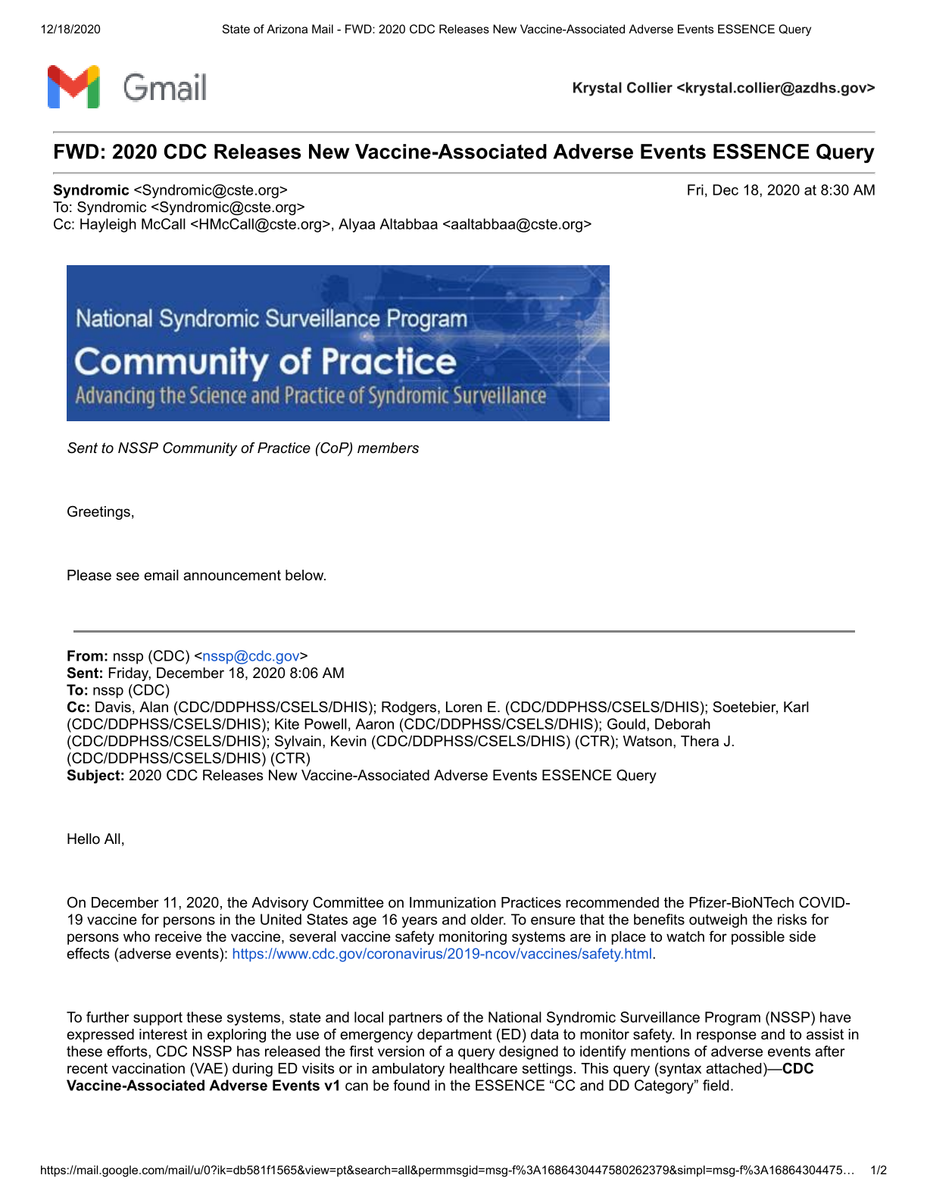
On December 11, 2020, the Advisory Committee on Immunization Practices recommended the Pfizer-BioNTech COVID-19 vaccine for persons in the United States age 16 years and older. To ensure that the benefits outweigh the risks for persons who receive the vaccine, several vaccine safety monitoring systems are in place to watch for possible side effects (adverse events): https://www.cdc.gov/coronavirus/2019-ncov/vaccines/safety.html.
On December 11, 2020, the Advisory Committee on Immunization Practices recommended the Pfizer-BioNTech COVID-19 vaccine for persons in the United States age 16 years and older. To ensure that the benefits outweigh the risks for persons who receive the vaccine, several vaccine safety monitoring systems are in place to watch for possible side effects (adverse events): https://www.cdc.gov/coronavirus/2019-ncov/vaccines/safety.html.
To further support these systems, state and local partners of the National Syndromic Surveillance Program (NSSP) have expressed interest in exploring the use of emergency department (ED) data to monitor safety. In response and to assist in these efforts, CDC NSSP has released the first version of a query designed to identify mentions of adverse events after recent vaccination (VAE) during ED visits or in ambulatory healthcare settings. This query (syntax attached)—CDC Vaccine-Associated Adverse Events v1 can be found in the ESSENCE “CC and DD Category” field.
The query includes a broad combination of diagnosis codes (ICD-10, ICD-9, and SNOMED) and chief complaint terms to detect visits potentially related to an adverse reaction after recent vaccination (e.g., poisoning, anaphylactic reaction, infection, post-vaccination fever, meningoencephalitis). This query does not attempt to identify specific clinical outcomes.
Given that discharge diagnosis can lag after chief complaint and is occasionally less complete, the NSSP team included chief complaint terms to improve timeliness and provide detailed reason-for-visit information. The chief complaint terms are designed to be more sensitive than specific and could identify ED visits unrelated to a recent vaccination or associated adverse event.

"With the existing VAE query, we didn't want to explicitly limit it to vaccine names/types/targets because of the often lack of those data points in CCs. Doesn't mean they won't be there, but for the best national picture and query that works best across multiple jurisdictions we felt being non-specific in that way was important.
That would link the two fields with an "AND" so you'd still get the speedy processing time of the CCDD Category and just be tacking a few extra "AND" requirements onto it.
You can also hear more on about these suggestions during the December Syndrome Definition Subcommittee Call when posted to the Knowledge Repository: https://knowledgerepository.syndromicsurveillance.org/syndrome-definition-committee
The ADHS Syndromic Surveillance Team are asking additional information on this new guidance for training purposes such as visualizations for setting these queries and what surveillance questions do each of the approaches answers, etc. Any questions that you all have, please comment below and we can ask NSSP.
As we understand more about these recommendations we will provide training on future Exploratory Analysis Subgroup/AZ BioSense Opioid Workgroup Calls.
Krystal
1. To map out facilities by count of adverse events. Shows concentrations of COVID specific reactions by hospital or ED.
2. I run the report to catch all the adverse events, then filter out non-covid vaccines. Then search for Pfizer, Moderna, COVID, Corona, etc.
3. Once complete the identified patients can be checked against recent deaths, previous COVID infections, severe illness, comorbidities, etc.
4. I collect all the case details in condensed excel file showing only the following: BP, Temp, O2, BMI, DX, ED, Inpatient, total days/hours, and full clinical summary. This is provided to an internal physician group to review and follow up as needed.