










AZ BioSense Community of Practice

The mission of the Arizona BioSense Workgroup is to work collaboratively as partners to build capacity and quality of BioSense syndromic surveillance in Arizona. Our vision is to improve population health and emergency response through the use of timely and effective syndromic surveillance. This space is a platform for our members to continue discussions and share cross-role topics and questions from providing the data to using syndromic data (clinician/IT/public health).

Save the Date + Updated Registration for the 2021 Syndromic Surveillance Symposium

Greetings,
 
Registration for the 2021 Syndromic Surveillance Symposium is NOW OPEN! Please see below for more information.


Mark Your Calendars
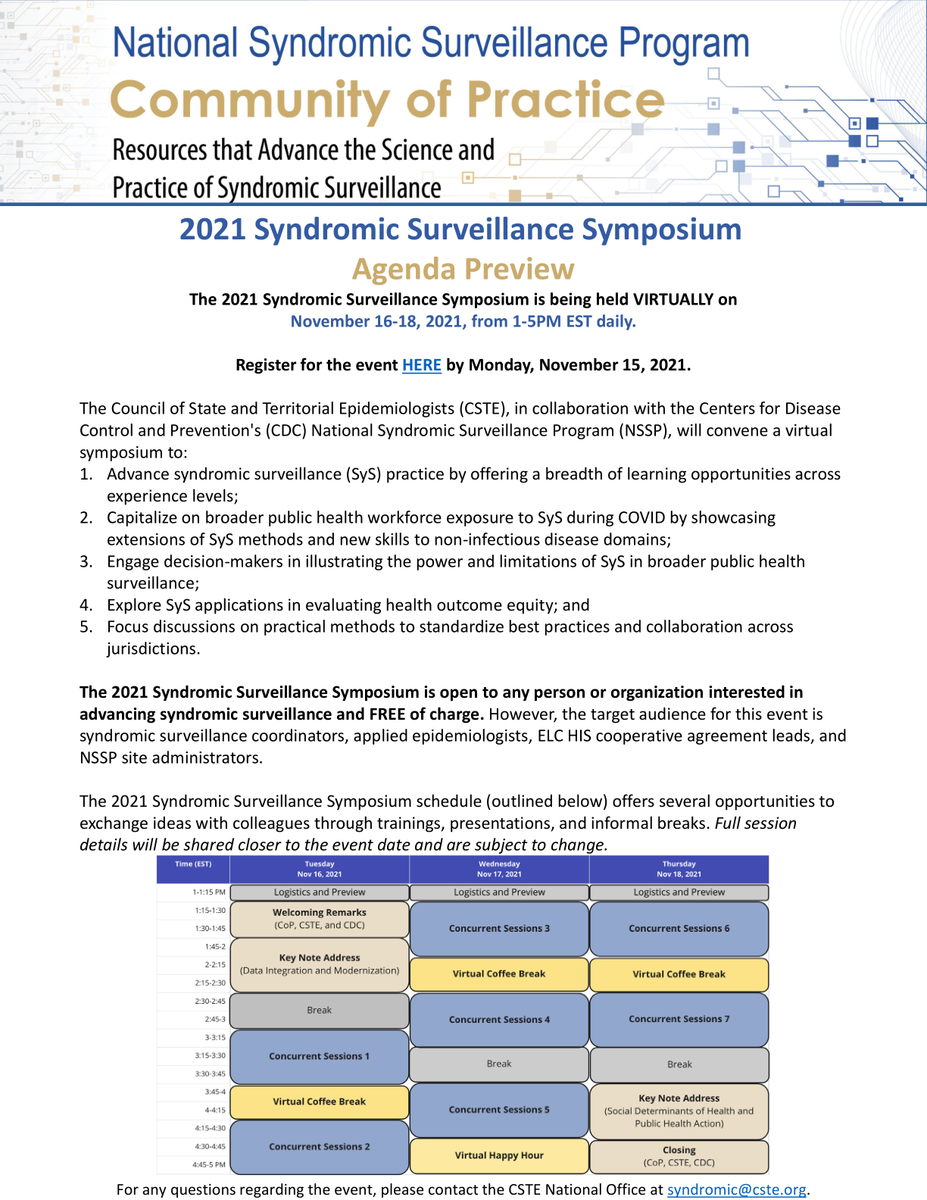
The Council of State and Territorial Epidemiologists (CSTE), in collaboration with the Centers for Disease Control and Prevention's (CDC) National Syndromic Surveillance Program (NSSP), will virtually convene the 2021 Syndromic Surveillance Symposium on November 16-18, 2021 from 1-5pm EST. 
 

You’re Invited
The event is open to any person or organization interested in advancing SyS practice and FREE of charge. However, the target audience for this event is syndromic surveillance coordinators and practitioners, applied epidemiologists, ELC HIS cooperative agreement leads, and NSSP site administrators.
 

Register Today
Registration for the 2021 Syndromic Surveillance Symposium is open NOW through EOD Monday, November 15, 2021. All interested participants must register for the event in advance by completing the registration formSee attached for the event flyer and below for more information.
 

Learn More
The 2021 Syndromic Surveillance Symposium aims to:
1.       Advance syndromic surveillance (SyS) practice by offering a breadth of learning opportunities across experience levels;
2.       Capitalize on broader public health workforce exposure to SyS during COVID by showcasing extensions of SyS methods and new skills to non-infectious disease domains; 
3.       Engage decision-makers in illustrating the power and limitations of SyS in broader public health surveillance;
4.       Explore SyS applications in evaluating health outcome equity; and
5.       Focus discussions on practical methods to standardize best practices and collaboration across jurisdictions.
 
The 2021 Syndromic Surveillance Symposium's schedule will offer several opportunities to exchange ideas with colleagues through trainings, presentations, and informal breaks. Full session details will be shared closer to the event date and are subject to change.


Contact Us
For any questions regarding the 2021 Syndromic Surveillance Symposium, please contact the CSTE National Office at syndromic@cste.org.
 
We look forward to (virtually) seeing you in mid-November!
 
Syndromic Surveillance @ CSTE
Hayleigh McCall, MPH | Alyaa Altabbaa, MPH
Council of State and Territorial Epidemiologists
“Using the power of epidemiology to improve the public’s health”
CSTE.orgMembershipFacebookTwitterInstagram
2635 Century Parkway NE, Suite 700, Atlanta, GA 30345
Tel: 770.458.3811 | Fax: 770.458.8516
 
Documents with personal data and/or confidential information
must be sent to CSTE’s national office only through a secure
ShareFile request and not through regular email.
Comments & Events

Krystal Collier, Syndromic Surveillance Program Coordinator


Hi all-

Use the Basecamp website to add calendar appts for sessions you wish to attend: 2021 Syndromic Surveillance Symposium

Here are the AZ sessions at the Symposium you might want to check out and support your AZ syndromic colleagues:

Day 1, 11/16/2021

3:00 PM EST Roundtable: Overdose Spike Alert Toolkit

Track: Topical Use Cases

Description: Discuss recent findings from the CSTE Overdose Spike Alert Advisory Group 

including innovative ideas and emerging topics in overdose anomaly 

detection and response.

Facilitators: 

• Krystal Collier, BA – Arizona Department of Health Services

• David Swenson, BS, Med – State of NH Department of Health and Human 

Services

• Sydney Fox, MPA – The Overdose Response Strategy (ORS)


Day 2, 11/17/2021

1:15 PM EST Roundtable: Urgent! Expanding Syndromic Community Data Quality Metrics to Urgent 

Care Clinics

Join Here:

Track: Data Methods and Integration

Description: The NSSP Community of Practice (CoP) Data Quality Subcommittee, 

working with the National Syndromic Surveillance Program (NSSP) and 

other partners, have observed a consensus gap in urgent care data 

quality metrics regarding: 

1. How to identify UCC data

2. What tools to use in onboarding and evaluating UCC data

3. Where to get more UCC information regarding preferences and 

practices 

Thus, this roundtable partner discussion (with NSSP CoP syndromic 

surveillance, Federal partners like CDC and ONC, and others) is being led 

to reach consensus on what data quality metrics should be used to 

evaluate urgent care clinic (UCC) data. 

• This will be based on standardized practices agreed upon by 

partners through a collaborative effort. 

• Help us to reach consensus on the right metrics for urgent care data 

quality. 

Facilitator: Krystal Collier, BA – Arizona Department of Health Services

 
1:15 PM EST Breakout: Some is Better than None - Expanding Syndromic Programs in State, 

Territorial, and Local Public Health Agencies

Join Here:

Track: Practical Applications

Description: Hear how three public health agencies determined the need to establish 

and grow their SyS programs.

Moderator: Anna Frick, MPH – State of Alaska Section of Epidemiology

Presenters: 

• Beda Mundo, AA Liberal Arts, BS Health Studies – Commonwealth HealthCare 

Corporation, Saipan, MP

• Nate Wright, MPH – Minnesota Department of Health

• Jacob Hojnacki, MPH – Coconino County Health and Human Services

• Sam Packard, MPH – Coconino County Health and Human Services


Day 3, 11/18/2021

1:15 PM EST Roundtable: Variability in Discharge Diagnoses Received and What Can Be Done About 

It

Join Here:

Track: Practical Applications

Description: Discuss solutions to improve discharge diagnoses data quality at collection, 

analysis, and interpretation. 

Facilitator: Samantha Spoto – Florida Department of Health


2:00 PM EST Coffee Break: NSSP CoP Data Quality Subcommittee

Join Here:

Track: Coffee Break

Description: Informal discussion on the first data quality "one-pager" and what to 

develop next.

Facilitators: 

• Jade Hodge – Kansas Department of Health and Environment

• Krystal Collier, BA – Arizona Department of Health Services

• David Swenson, BS, Med – State of NH Department of Health and Human 

Services

 
3:45 PM EST Breakout: Syndromic What? Sharing Data Outside of Public Health

Join Here:

Track: Data Methods and Integration

Description: Hear about expanding SyS awareness, access, and integration outside of 

traditional public health agencies.

Moderator: Mayank Modi, MD – Medical University of the Americas

Presenters:

• Gabriel Ann Haas, MPH – Kansas Department of Health and Environment

• Kellie Wark, MD, MPH – University of Kansas Medical Center

• Margaret Cullather, MPH – American College of Emergency Physicians 

• Laura Fox, MPH – Maricopa County Department of Public Health and Arizona 

Department of State Health Services

• Paul Iniguez, B.S., M.A. – NOAA/NWS Phoenix, AZ

• Aaron Gettel, MPH – Maricopa County Department of Public Health

 
2:30 PM EST Roundtable: Utility and Challenges in Monitoring Social Determinants of Health Using 

Syndromic Surveillance

Join Here:

Track: Data Methods and Integration

Description: Discuss the various SDOH metrics that can be evaluated in syndromic 

surveillance data, challenges encountered in collecting these data, and 

tangible next steps to improve data collection.

Facilitator: Lakshmi Radhakrishnan, MPH – CDC/NSSP
 

2:30 PM EST Breakout: Better Practice through Advanced Analytics

Join Here:

Track: Practical Applications

Description: Discover applications of advanced analytics to 1) ease syndrome defining 

work with machine learning and 2) reducing nuisance alerts in ESSENCE.

Moderator: Sara Chronister, MPH – Maricopa County Department of Public Health (AZ)

Presenters: 

• Hannah P. Cowley, Bachelors of Arts in Cognitive Science – The Johns Hopkins 

University Applied Physics Laboratory

• Michael Sheppard, MS – CDC/NSSP

• Howard Burkom, PhD – Johns Hopkins University Applied Physics Laboratory