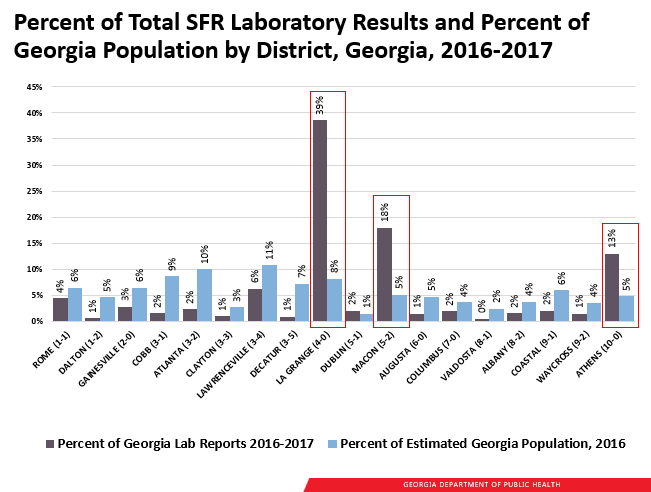
I know a lot of people were unable to attend CSTE, so I thought I'd share some key findings of a lightning round I presented there, just to generate some discussion. Something we found in Georgia was that our positive laboratory results for SFR were not evenly distributed throughout the state. We have 3 public health districts that are burdened with 70% of the state's positive laboratory results but only share 18% of the state's population.
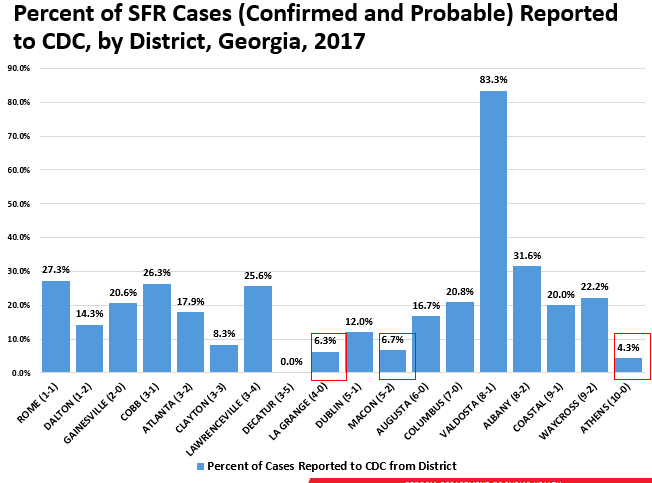
When we thought that maybe we actually had a SFR problem in those areas, we pulled up how many of those laboratory results actually resulted in a confirmed or probable case, and the results were unimpressive. These districts had incredibly low numbers of actual cases.
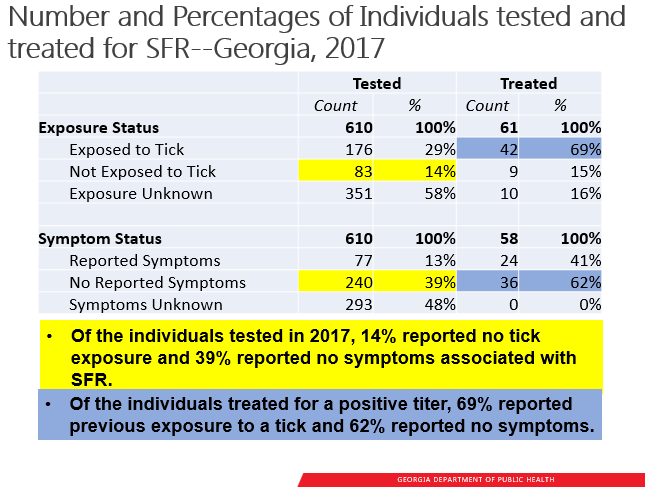
To us, this indicates that the providers are testing (and possibly catching a lot of false-positives or seropositive asymptomatic individuals) without looking for symptoms. To look at this, we analyzed the number and percentages of individuals tested and treated for SFR and found that 39% of individuals tested for SRF had no symptoms associated with SFR but 69% of individuals treated for their SFR diagnosis had reported exposure to a tick.
To me, this is evidence that providers are diagnosing and treating based on titers, not symptoms.
When we talk about the goal of our case definition and surveillance, a few concepts repeatedly come up:
Timely and appropriate treatment of patient is the primary concern and surveillance is always secondary to this.
Surveillance is intended to give providers data to make informed decisions to test for diseases commonly found in their areas.
Some logical leaps we make from these concepts is that:
SFR seems to be over-counted leading many providers to test and treat for it unnecessarily.
More testing for SFR (with an assumed seropositivity of 4-11% based geographic location - unpublished data) will lead to more positive results thus this "negative" behavior of testing without appropriate symptoms continues.
I know CDC has indicated that they're working on tools for providers to help educate them on this issue, but I want to stress the importance of educating providers. Unfortunately in Georgia, those three districts have become gossip hot-spots for SFR, with everybody and their mother telling everyone to get tested if they have any feelings of illness. Everyone in these areas "knows" that SFR (well, RMSF to them) is abundant in Georgia because just about "everyone" is testing positive for it. Honestly, it's following the same route of lyme where we have people insisting that it is the answer they've been waiting for, even if their symptoms don't make sense for the diagnosis.
I realize this is a long post, but I have been working on this issue for a while in Georgia and I'm craving discussion with other states.
Comments & Events
Sara Reilly
Shawna, Great info! Sorry I am just getting to it. Couple of thoughts:
1. When you say treated, is there indication as to whether treatment occurred before or after testing? Recognizing that in symptomatic patients (even early in illness) the current guidance is for physicians to treat without waiting for test results due to severity of illness with delayed treatment. 2. Were any of the patients tested without symptoms OR history of tick exposure? Those would be the most worrisome to me, because those are the patients and physicians testing for any feelings of illness. Patients with mild (though not clinically compatible) symptoms with a history of tick exposure may have reason to be tested (and subsequently treated depending on symptoms), though I would agree that tick exposure alone should not warrant treatment. Patients and physicians testing and treating for tick exposure alone may be misinformed about prophylactic indication for SFR - we see this a lot in Maryland since we have a lot of Lyme. 3. Have y'all been attempting to tease out other SFR in Georgia? In Maryland we have been specifically asking about eschar in our milder cases and trying to encourage convalescent testing in light of the Gulf Coast tick being found more abundantly on the eastern shore, but we have not been able to confirm any local R. parkeri or other SFR.
Thanks for responding! To answer your questions: 1. When you say treated, is there indication as to whether treatment occurred before or after testing? Recognizing that in symptomatic patients (even early in illness) the current guidance is for physicians to treat without waiting for test results due to severity of illness with delayed treatment. In our data, the patients came in for testing, and walked out with a prescription for doxy same day. Test results might have come in after treatment, but the draw was done pre-treatment.
2. Were any of the patients tested without symptoms OR history of tick exposure? Those would be the most worrisome to me, because those are the patients and physicians testing for any feelings of illness. Patients with mild (though not clinically compatible) symptoms with a history of tick exposure may have reason to be tested (and subsequently treated depending on symptoms), though I would agree that tick exposure alone should not warrant treatment. Patients and physicians testing and treating for tick exposure alone may be misinformed about prophylactic indication for SFR - we see this a lot in Maryland since we have a lot of Lyme. In GA, we don't have a lot of lyme, but we DO see treatment based on tick "exposure" a lot. Same for SFR, I believe we only average 60 cases (confirmed or probable) each year, but we get TONS of testing for it. Unfortunately our old CRF that I'm trying to phase out, did not distinguish between exposures such as: in wooded area vs removed attached tick. So we lack information on how many actually saw a tick or removed one. Although in many clinical notes, physicians would remark that the patient had been outdoors and made no reference to a specific tick bite. There are instances where an individual actually said he or she had no exposure to ticks and had no symptoms and yet was tested (and possibly treated) for SFR. These numbers are lower, but also worrisome to me.
3. Have y'all been attempting to tease out other SFR in Georgia? In Maryland we have been specifically asking about eschar in our milder cases and trying to encourage convalescent testing in light of the Gulf Coast tick being found more abundantly on the eastern shore, but we have not been able to confirm any local R. parkeri or other SFR. Unfortunately no.















Great info! Sorry I am just getting to it. Couple of thoughts:
1. When you say treated, is there indication as to whether treatment occurred before or after testing? Recognizing that in symptomatic patients (even early in illness) the current guidance is for physicians to treat without waiting for test results due to severity of illness with delayed treatment.
2. Were any of the patients tested without symptoms OR history of tick exposure? Those would be the most worrisome to me, because those are the patients and physicians testing for any feelings of illness. Patients with mild (though not clinically compatible) symptoms with a history of tick exposure may have reason to be tested (and subsequently treated depending on symptoms), though I would agree that tick exposure alone should not warrant treatment. Patients and physicians testing and treating for tick exposure alone may be misinformed about prophylactic indication for SFR - we see this a lot in Maryland since we have a lot of Lyme.
3. Have y'all been attempting to tease out other SFR in Georgia? In Maryland we have been specifically asking about eschar in our milder cases and trying to encourage convalescent testing in light of the Gulf Coast tick being found more abundantly on the eastern shore, but we have not been able to confirm any local R. parkeri or other SFR.
Thanks for responding! To answer your questions:
1. When you say treated, is there indication as to whether treatment occurred before or after testing? Recognizing that in symptomatic patients (even early in illness) the current guidance is for physicians to treat without waiting for test results due to severity of illness with delayed treatment.
In our data, the patients came in for testing, and walked out with a prescription for doxy same day. Test results might have come in after treatment, but the draw was done pre-treatment.
2. Were any of the patients tested without symptoms OR history of tick exposure? Those would be the most worrisome to me, because those are the patients and physicians testing for any feelings of illness. Patients with mild (though not clinically compatible) symptoms with a history of tick exposure may have reason to be tested (and subsequently treated depending on symptoms), though I would agree that tick exposure alone should not warrant treatment. Patients and physicians testing and treating for tick exposure alone may be misinformed about prophylactic indication for SFR - we see this a lot in Maryland since we have a lot of Lyme.
In GA, we don't have a lot of lyme, but we DO see treatment based on tick "exposure" a lot. Same for SFR, I believe we only average 60 cases (confirmed or probable) each year, but we get TONS of testing for it. Unfortunately our old CRF that I'm trying to phase out, did not distinguish between exposures such as: in wooded area vs removed attached tick. So we lack information on how many actually saw a tick or removed one. Although in many clinical notes, physicians would remark that the patient had been outdoors and made no reference to a specific tick bite. There are instances where an individual actually said he or she had no exposure to ticks and had no symptoms and yet was tested (and possibly treated) for SFR. These numbers are lower, but also worrisome to me.
3. Have y'all been attempting to tease out other SFR in Georgia? In Maryland we have been specifically asking about eschar in our milder cases and trying to encourage convalescent testing in light of the Gulf Coast tick being found more abundantly on the eastern shore, but we have not been able to confirm any local R. parkeri or other SFR.
Unfortunately no.