














Titer Values and PPV
Hi all -
I've heard multiple times that some states applied their own cut off of 1:128 as a minimum titer value to initiate an investigation. I'm curious as to if anyone has looked that the positive predictive value of titers to determine if this is a worthwhile change to the case definition (it was mentioned at one point as a possibility)? Here in Georgia, we actually manually reviewed cases from 2017 to look at PPV by titer and found...nothing exciting (see below).
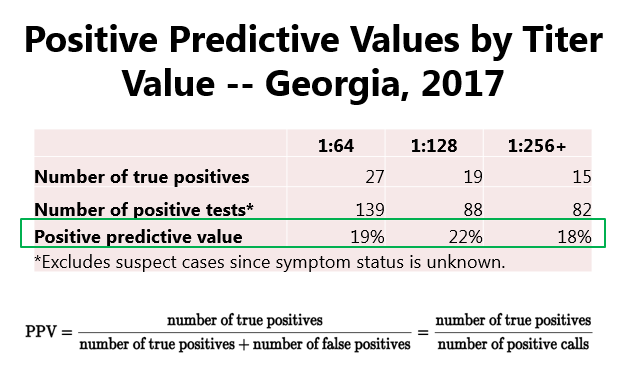
For this calculation, we used clinically compatible cases (i.e. those classified as confirmed or probable) to be our “true positives” and those who were not clinically compatible (i.e. those classified as “not a case”) as our “false positives.”
I've heard multiple times that some states applied their own cut off of 1:128 as a minimum titer value to initiate an investigation. I'm curious as to if anyone has looked that the positive predictive value of titers to determine if this is a worthwhile change to the case definition (it was mentioned at one point as a possibility)? Here in Georgia, we actually manually reviewed cases from 2017 to look at PPV by titer and found...nothing exciting (see below).
For this calculation, we used clinically compatible cases (i.e. those classified as confirmed or probable) to be our “true positives” and those who were not clinically compatible (i.e. those classified as “not a case”) as our “false positives.”
Granted, this is preliminary data, and we plan on looking at this again in 2018, but I'm intrigued by this result. Not only are we getting so few cases for so many positive lab results but higher titers do not seem to be associated with a higher PPV.
Thoughts?
Thoughts?
I liked you post, but when I tried to get into BaseCamp to respond to your positing, my BaseCcamp application hit a dead end ( it did not allow me access).
David Gaines, Virginia Dept. of Health.