


Page 14 - CSTE_2018-2020_AR
P. 14
Advocacy                                             Preparedness Act (PAHPA), which Congress passed on June 24, 2019,
                                                             including recommended language to authorize loan repayments.

                                                             Throughout the past two years, we joined like-minded partner
        As we reflect on our past two years of advocacy work in the middle of
                                                             organizations in advocating for myriad public health issues such as
        a pandemic, it is ever more apparent that our voices in Washington
                                                             antimicrobial resistance, food safety and advanced molecular detection,
        are essential to communicate the role that epidemiologists play in
                                                             tuberculosis, environmental health, behavioral health, occupational
        preventing, preparing for, and responding to public health emergencies.
                                                             health, injury and violence prevention, chronic disease, and more,
        COVID-19 has exposed deadly gaps in our public health system and we
                                                             better, faster data.
        have worked tirelessly to respond. As we continue to combat a pandemic
        that our system was not prepared for, we recognize it won’t be the last
                                                             In the end, our efforts were largely successful. Building on the increase
        public health threat to face our country. We know our voices must be
                                                             provided to CDC in the previous fiscal year, Congress provided CDC a
        a constant, and are needed—maybe even more so—outside of public
                                                             funding increase of $636 million in fiscal year 2020 that translated into
        health emergencies to advocate for a better, more robust public health
                                                             increases for CSTE priorities across the board, including ELC grants. For
        infrastructure. CSTE provides this voice for you in the nation’s capital,
                                                             the first time, with the help of Data: Elemental to Health, $50 million
        advocating for funding and policies that support your work.
                                                             was provided for the Data Modernization Initiative (DMI) to improve
                                                             public health data systems at CDC and state, territorial, local, and tribal
        Even before the onset of the COVID-19 pandemic, CSTE was busy in
                                                             health departments. The bill increased the infectious disease rapid
        Washington with the launch of the Data: Elemental to Health campaign
                                                             response fund by $35 million, and for the first time in 20 years, $12.5
        in 2018. Together, with partners APHL, National Association for Public
                                                             million was provided to support firearm injury and mortality prevention
        Health Statistics and Information Systems (NAPHSIS), and Healthcare
                                                             research. We built on that success as Congress worked to provide relief
        Information and Management Systems Society (HIMSS), we embarked
                                                             from COVID-19, securing an additional $500 million for the DMI in the
        on an important journey to secure $1 billion over 10 years to modernize
                                                             Coronavirus Aid, Relief, and Economic Security Act.
        data infrastructure at CDC. Through an annual appropriations request of
        $100 million, we aim to build a foundation for data modernization that
        can withstand the test of time and provide access for public health to
        data in real time. The campaign achieved its first victory, securing initial
        foundational funding of $50 million in fiscal year 2020.
        In addition to the campaign, CSTE continued our annual advocacy
        priorities for the CDC and within it, Epidemiology and Laboratory
        Capacity (ELC) grants, the public health workforce, and public health
        informatics. In 2019, we worked closely with key policymakers
        on language in the reauthorization of Pandemic and All-Hazards


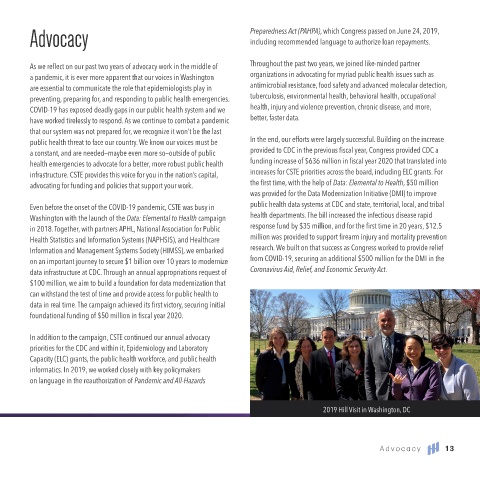
                                                                               2019 Hill Visit in Washington, DC


                                                                                            A dv ocac y     13

