


Page 14 - CSTE_Annual-Report_2017-18
P. 14
Building STLT Capacity                     •  Conducted assessment of infection prevention and control
                                                                 resources and capacity to assess state HAI programs’ infection
          •  Fostered shared learning and networking with 70 mentees and 54
                                                                 prevention and control resources, capacity, and activities following
            mentors as part of the CSTE Early Career Professionals Mentorship
                                                                 2014 Ebola funding.
            Program.
                                                               •  The MCH Subcommittee formed a Neonatal Abstinence Syndrome
          •  In partnership with CDC, hosted a four-part webinar series to build
                                                                 (NAS) Workgroup and developed an assessment of state
            evaluation capacity among epidemiologists.
                                                                 surveillance practices and data sources for NAS.
          •  Continued to support initial Electronic Case Reporting (eCR)
                                                               •  Formed the Data Standardization Workgroup to address
            implementation sites utilizing RCKMS through the Digital Bridge
                                                                 jurisdictional reporting variation by developing consensus in the
            Initiative.
                                                                 interpretation of data elements used in state reporting to CDC,
          •  Conducted the 2017 State Reportable Conditions Assessment
                                                                 information exchange between states, and analysis.
            (SRCA) to capture reportable conditions and requirements by state.
                                                               •  Formed the Data Release Workgroup to develop guidance and
                                                                 suggested language for public health agencies to develop release
            Funded nine jurisdictions for                        and suppression policies for aggregate data.
             novel surveillance projects                       •  Six states (Alaska, Maine, New York, New Mexico, West Virginia,
                                                                 Pennsylvania) implemented the 12-Question Marijuana and
                                                                 Prescription Drug Supplement in the Pregnancy Risk Assessment
          •  Funded nine jurisdictions to implement novel surveillance projects
                                                                 Monitoring System (PRAMS)
            to address emerging issues in substance use and mental health.
                                                               •  The Marijuana Subcommittee completed an environmental scan of
          •  Funded five jurisdictions to pilot the expansion of existing
                                                                 state marijuana surveillance with responses from 35 states.
            influenza surveillance systems and informatics to facilitate the
            exchange of data necessary to determine the weekly proportion
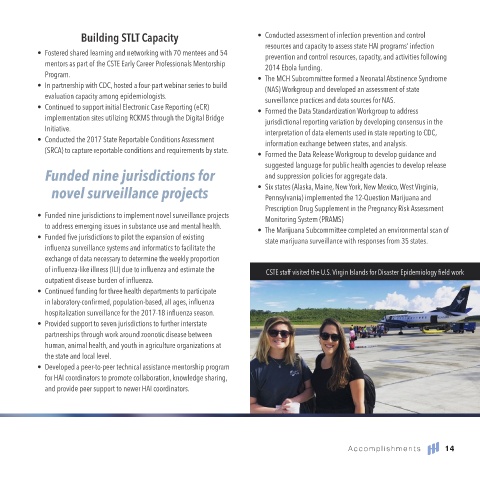
            of influenza-like illness (ILI) due to influenza and estimate the   CSTE staff visited the U.S. Virgin Islands for Disaster Epidemiology field work
            outpatient disease burden of influenza.
          •  Continued funding for three health departments to participate
            in laboratory-confirmed, population-based, all ages, influenza
            hospitalization surveillance for the 2017-18 influenza season.
          •  Provided support to seven jurisdictions to further interstate
            partnerships through work around zoonotic disease between
            human, animal health, and youth in agriculture organizations at
            the state and local level.
          •  Developed a peer-to-peer technical assistance mentorship program
            for HAI coordinators to promote collaboration, knowledge sharing,
            and provide peer support to newer HAI coordinators.


                                                                                     A ccomplishmen t s     14

