


Page 17 - CSTE_Annual-Report_2017-18
P. 17
Created in 2003, the Applied Epidemiology Fellowship (AEF)
        is designed for recent master’s or doctoral-level graduates in
        epidemiology or a related field who are interested in public health
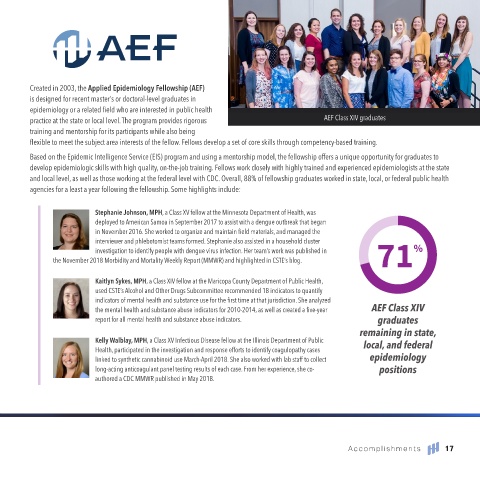
        practice at the state or local level. The program provides rigorous    AEF Class XIV graduates
        training and mentorship for its participants while also being
        flexible to meet the subject area interests of the fellow. Fellows develop a set of core skills through competency-based training.
        Based on the Epidemic Intelligence Service (EIS) program and using a mentorship model, the fellowship offers a unique opportunity for graduates to
        develop epidemiologic skills with high quality, on-the-job training. Fellows work closely with highly trained and experienced epidemiologists at the state
        and local level, as well as those working at the federal level with CDC. Overall, 88% of fellowship graduates worked in state, local, or federal public health
        agencies for a least a year following the fellowship. Some highlights include:

                        Stephanie Johnson, MPH, a Class XV fellow at the Minnesota Department of Health, was
                        deployed to American Samoa in September 2017 to assist with a dengue outbreak that began
                        in November 2016. She worked to organize and maintain field materials, and managed the
                        interviewer and phlebotomist teams formed. Stephanie also assisted in a household cluster   %
                        investigation to identify people with dengue virus infection. Her team’s work was published in   71
              the November 2018 Morbidity and Mortality Weekly Report (MMWR) and highlighted in CSTE’s blog.

                        Kaitlyn Sykes, MPH, a Class XIV fellow at the Maricopa County Department of Public Health,
                        used CSTE’s Alcohol and Other Drugs Subcommittee recommended 18 indicators to quantify
                        indicators of mental health and substance use for the first time at that jurisdiction. She analyzed
                        the mental health and substance abuse indicators for 2010-2014, as well as created a five-year   AEF Class XIV
                        report for all mental health and substance abuse indicators.        graduates
                                                                                       remaining in state,
                        Kelly Walblay, MPH, a Class XV Infectious Disease fellow at the Illinois Department of Public   local, and federal
                        Health, participated in the investigation and response efforts to identify coagulopathy cases
                        linked to synthetic cannabinoid use March-April 2018. She also worked with lab staff to collect   epidemiology
                        long-acting anticoagulant panel testing results of each case. From her experience, she co-  positions
                        authored a CDC MMWR published in May 2018.


                                                                                     A ccomplishmen t s     17

