


Page 25 - Driving Public Health in the Fast Lane
P. 25
databases to get comprehensive data around the overdose death. As medical examiners and coroners
            work to determine the cause of death, they create a record that is unique to their system (some are paper/
            file systems) where toxicology laboratory results, patient history, additional records, and documents are
            stored. This medical examiner record is not linked to the health care system’s EHR and is not accessible to
            the public health department, vital records registrar, or the EDRS. If an epidemiologist needs data to help
            inform decision making to address a local outbreak, a manual request must be made over the phone or
            through email to the medical examiner or coroner. The information is then faxed to the health department
            for manual input into another database. There are no national consensus-based standards for how the
            data should be stored in the EHR or shared with public health.


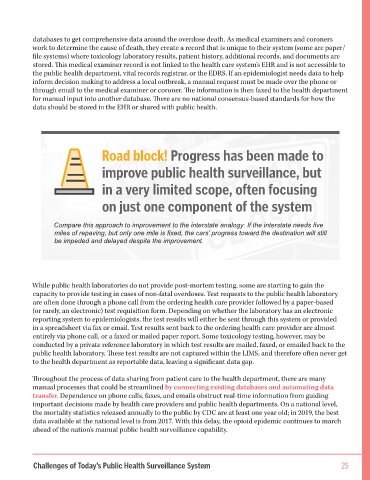
                                   Road block! Progress has been made to


                                   improve public health surveillance, but

                                   in a very limited scope, often focusing


                                   on just one component of the system

                   Compare this approach to improvement to the interstate analogy: If the interstate needs five
                   miles of repaving, but only one mile is fixed, the cars’ progress toward the destination will still
                   be impeded and delayed despite the improvement.


            While public health laboratories do not provide post-mortem testing, some are starting to gain the
            capacity to provide testing in cases of non-fatal overdoses. Test requests to the public health laboratory
            are often done through a phone call from the ordering health care provider followed by a paper-based
            (or rarely, an electronic) test requisition form. Depending on whether the laboratory has an electronic
            reporting system to epidemiologists, the test results will either be sent through this system or provided
            in a spreadsheet via fax or email. Test results sent back to the ordering health care provider are almost
            entirely via phone call, or a faxed or mailed paper report. Some toxicology testing, however, may be
            conducted by a private reference laboratory in which test results are mailed, faxed, or emailed back to the
            public health laboratory. These test results are not captured within the LIMS, and therefore often never get
            to the health department as reportable data, leaving a significant data gap.

            Throughout the process of data sharing from patient care to the health department, there are many
            manual processes that could be streamlined by connecting existing databases and automating data
            transfer. Dependence on phone calls, faxes, and emails obstruct real-time information from guiding
            important decisions made by health care providers and public health departments. On a national level,
            the mortality statistics released annually to the public by CDC are at least one year old; in 2019, the best
            data available at the national level is from 2017. With this delay, the opioid epidemic continues to march
            ahead of the nation’s manual public health surveillance capability.


            Challenges of Today’s Public Health Surveillance System                                               25

