


Page 26 - Driving Public Health in the Fast Lane
P. 26
Foodborne Outbreak


        Illnesses caused by foodborne disease agents are commonplace in the United States with approximately
                                                                                                   13
        48 million people getting sick, resulting in 128,000 hospitalizations and 3,000 deaths per year.  In the event
        of a multi-state foodborne outbreak, timely, complete, and accurate exchange of data between public
        health agencies at the federal, state, territorial, local, and tribal level is critical to identify and remove the
        source of contamination and prevent further illness.


        Since 1996, PulseNet—a national network of 83 laboratories that uses DNA “fingerprints” to identify
        bacteria causing foodborne illness—has facilitated the exchange of data to mitigate local and multi-
        state outbreaks. People who have been sickened by bacteria with similar DNA fingerprints can be linked
        to other people who consumed the same contaminated food. This allows public health professionals
        to identify a foodborne outbreak, determine its cause, and take actions such as a food recall to prevent
        further illness. PulseNet relies on standardized methods and a secure online database that allows for the
        real-time exchange of data between public health laboratories and federal agencies such as CDC, the Food
        and Drug Administration, and United States Department of Agriculture, revolutionizing the ability to
        detect and respond to foodborne outbreaks quickly and efficiently. Essential to the vitality of PulseNet is
                                                 14
        the timely exchange of standardized data.  And while linkages of the laboratory data have been crucial to
        detect outbreaks, the system is not linked to the epidemiological data systems that store the information
        necessary to determine the likely cause of the outbreak.

        Advanced molecular detection (AMD) has also integrated new technologies and disciplines, such as
        next generation sequencing (NGS) and bioinformatics, into traditional disease investigation methods.
        By providing a greater level of detail and information on the genetic makeup of pathogens, NGS enables
        public health professionals to detect the occurrence of related illnesses—signaling a cluster or outbreak—
        and respond to public health threats more rapidly and effectively. Highly specialized data scientists in


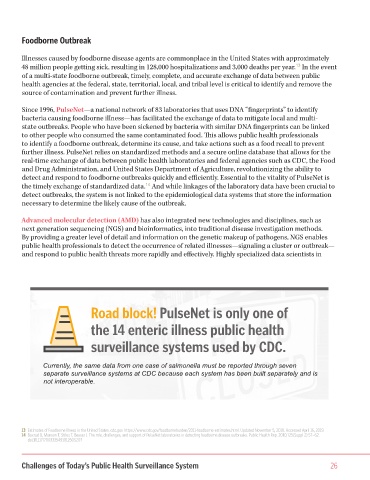
                               Road block! PulseNet is only one of

                               the 14 enteric illness public health


                               surveillance systems used by CDC.

               Currently, the same data from one case of salmonella must be reported through seven
               separate surveillance systems at CDC because each system has been built separately and is
               not interoperable.


        13  Estimates of Foodborne Illness in the United States. cdc.gov. https://www.cdc.gov/foodborneburden/2011-foodborne-estimates.html. Updated November 5, 2018. Accessed April 16, 2019.
        14  Boxrud D, Monson T, Stiles T, Besser J. The role, challenges, and support of PulseNet laboratories in detecting foodborne disease outbreaks. Public Health Rep. 2010;125(Suppl 2):57–62.
          doi:10.1177/00333549101250S207


        Challenges of Today’s Public Health Surveillance System                                               26

