


Page 30 - Driving Public Health in the Fast Lane
P. 30
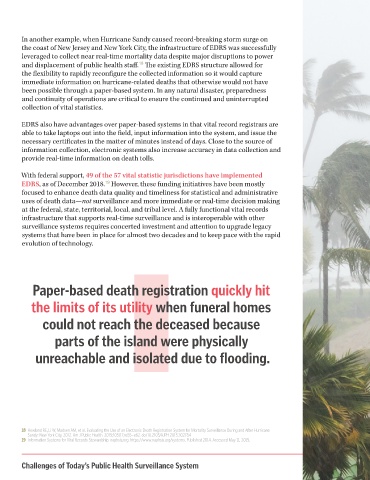
In another example, when Hurricane Sandy caused record-breaking storm surge on
        the coast of New Jersey and New York City, the infrastructure of EDRS was successfully
        leveraged to collect near real-time mortality data despite major disruptions to power
        and displacement of public health staff.  The existing EDRS structure allowed for
                                               18
        the flexibility to rapidly reconfigure the collected information so it would capture
        immediate information on hurricane-related deaths that otherwise would not have
        been possible through a paper-based system. In any natural disaster, preparedness
        and continuity of operations are critical to ensure the continued and uninterrupted
        collection of vital statistics.


        EDRS also have advantages over paper-based systems in that vital record registrars are
        able to take laptops out into the field, input information into the system, and issue the
        necessary certificates in the matter of minutes instead of days. Close to the source of
        information collection, electronic systems also increase accuracy in data collection and
        provide real-time information on death tolls.

        With federal support, 49 of the 57 vital statistic jurisdictions have implemented
                                    19
        EDRS, as of December 2018.  However, these funding initiatives have been mostly
        focused to enhance death data quality and timeliness for statistical and administrative
        uses of death data—not surveillance and more immediate or real-time decision making
        at the federal, state, territorial, local, and tribal level. A fully functional vital records
        infrastructure that supports real-time surveillance and is interoperable with other
        surveillance systems requires concerted investment and attention to upgrade legacy
        systems that have been in place for almost two decades and to keep pace with the rapid
        evolution of technology.


            Paper-based death registration quickly hit


           the limits of its utility when funeral homes

               could not reach the deceased because


                   parts of the island were physically

             unreachable and isolated due to flooding.


        18  Howland RE, Li W, Madsen AM, et al. Evaluating the Use of an Electronic Death Registration System for Mortality Surveillance During and After Hurricane
          Sandy: New York City, 2012. Am J Public Health. 2015;105(11):e55–e62. doi:10.2105/AJPH.2015.302784
        19  Information Systems for Vital Records Stewardship. naphsis.org. https://www.naphsis.org/systems. Published 2014. Accessed May 11, 2019.


        Challenges of Today’s Public Health Surveillance System                                               30

