


Page 32 - Driving Public Health in the Fast Lane
P. 32
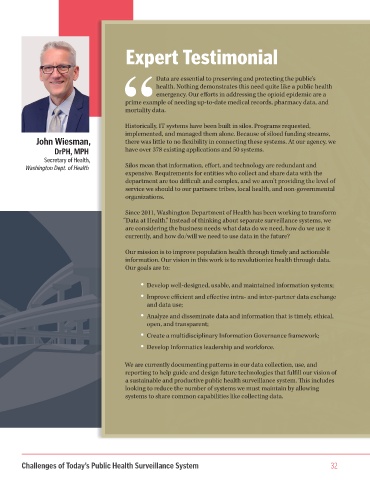
Expert Testimonial


                                                     Data are essential to preserving and protecting the public’s
                                                     health. Nothing demonstrates this need quite like a public health
                                                     emergency. Our efforts in addressing the opioid epidemic are a
                                          prime example of needing up-to-date medical records, pharmacy data, and
                                          mortality data.

                                          Historically, IT systems have been built in silos. Programs requested,
                                          implemented, and managed them alone. Because of siloed funding streams,
             John Wiesman,                there was little to no flexibility in connecting these systems. At our agency, we
                   DrPH, MPH              have over 378 existing applications and 50 systems.
                Secretary of Health,
         Washington Dept. of Health       Silos mean that information, effort, and technology are redundant and
                                          expensive. Requirements for entities who collect and share data with the
                                          department are too difficult and complex, and we aren’t providing the level of
                                          service we should to our partners: tribes, local health, and non-governmental
                                          organizations.

                                          Since 2011, Washington Department of Health has been working to transform
                                          “Data at Health.” Instead of thinking about separate surveillance systems, we
                                          are considering the business needs: what data do we need, how do we use it
                                          currently, and how do/will we need to use data in the future?

                                          Our mission is to improve population health through timely and actionable
                                          information. Our vision in this work is to revolutionize health through data.
                                          Our goals are to:


                                                • Develop well-designed, usable, and maintained information systems;
                                                • Improve efficient and effective intra- and inter-partner data exchange
                                                  and data use;
                                                • Analyze and disseminate data and information that is timely, ethical,
                                                  open, and transparent;
                                                • Create a multidisciplinary Information Governance framework;

                                                • Develop Informatics leadership and workforce.

                                          We are currently documenting patterns in our data collection, use, and
                                          reporting to help guide and design future technologies that fulfill our vision of
                                          a sustainable and productive public health surveillance system. This includes
                                          looking to reduce the number of systems we must maintain by allowing
                                          systems to share common capabilities like collecting data.


        Challenges of Today’s Public Health Surveillance System                                               32

